One of the strangest things about English interviews is that the pace that sounds confident to interviewers often feels painfully slow to the speaker.
Especially in technical interviews.
Most non-native candidates leave interviews with the same impression:
“I was nervous, but I think I explained everything.”
Then they listen to a recording.
The pace is rushed. Sentences blur together. Ideas arrive faster than the listener can process them. Fillers appear between thoughts because the brain is trying to catch up to the mouth.
This is why speaking pace matters more than most candidates realize. In technical interviews, clarity is evaluated continuously — not just the correctness of your answer.
And for most non-native speakers, the optimal pace is slower than instinct suggests.
WhalePrep observation: The majority of first-time practice sessions land between 145–175 WPM. Candidates almost always believe they're speaking slower than they actually are.
Why interview pace feels different in your head
When you're speaking in a second language, your internal perception of speed becomes unreliable.
Your brain is doing far more work than it would in your native language:
- translating concepts,
- searching vocabulary,
- managing grammar,
- planning structure,
- monitoring pronunciation,
- thinking about the actual technical problem.
That cognitive load creates urgency. Silence feels dangerous. Pauses feel longer than they really are. So the natural instinct is to speed up.
Ironically, that usually makes answers harder to follow.
Technical interviews are especially sensitive to this because interviewers are trying to simultaneously:
- understand your reasoning,
- evaluate technical depth,
- follow terminology,
- and assess communication quality.
Once pace becomes too fast, comprehension starts dropping even if the content itself is correct.
The important thing is that 128 WPM does not feel smooth to most candidates at first.
It feels unusually calm.
Almost too calm.
That's why so many people accidentally overspeed during interviews without realizing it.
So what does 128 WPM actually sound like?
Not robotic. Not slow-motion. Not artificially careful.
It sounds like someone thinking while speaking.
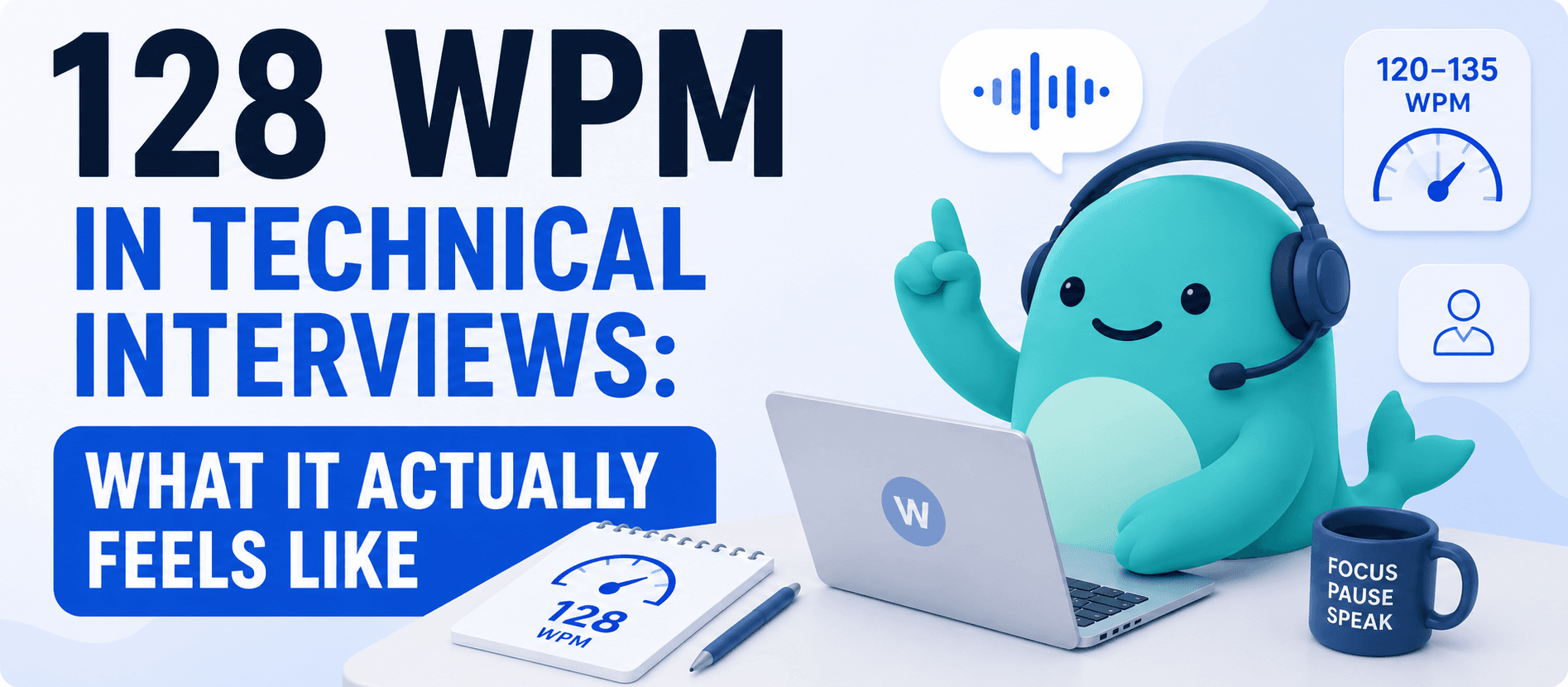
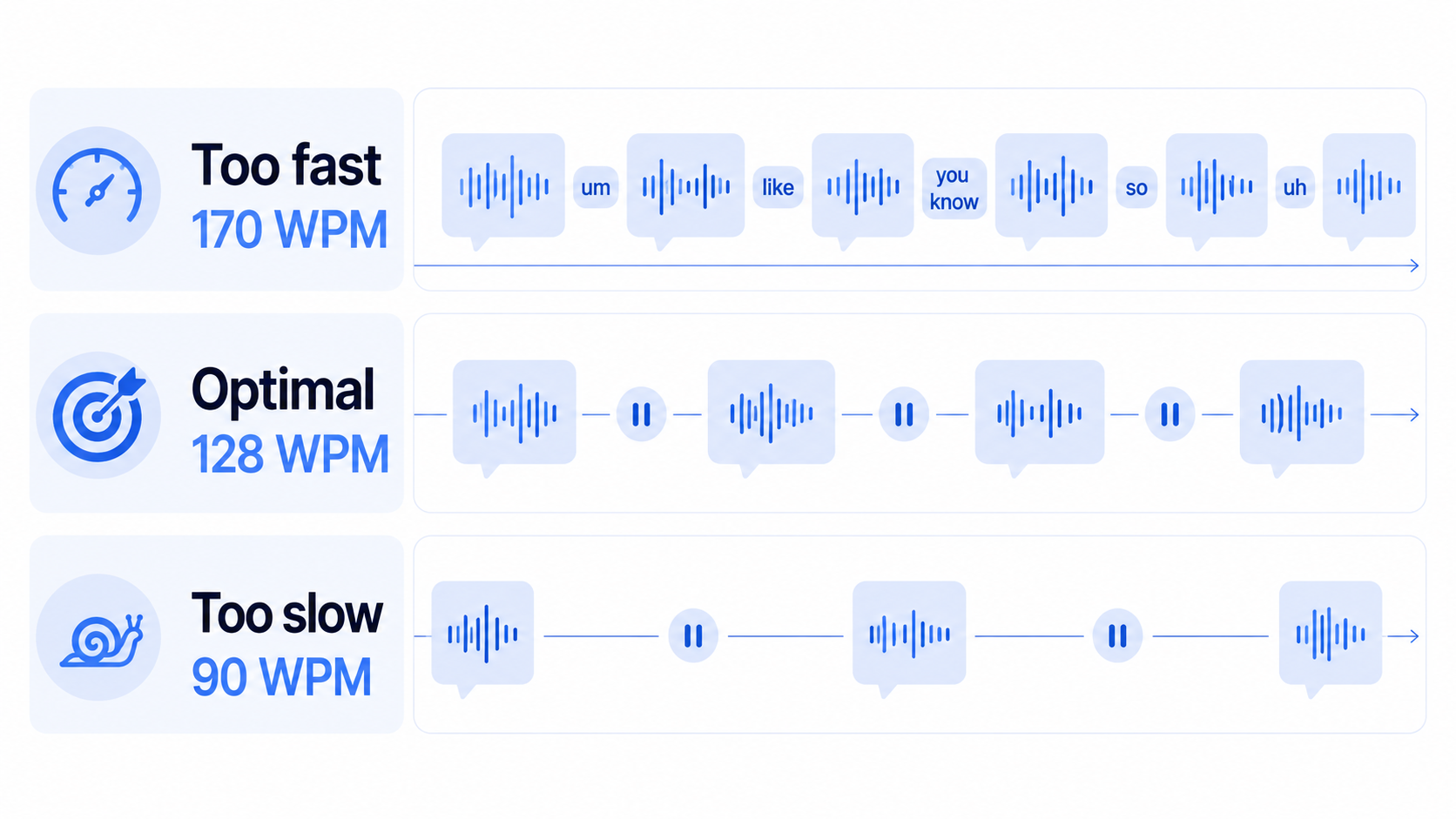
At roughly 120–135 WPM:
- sentences have separation,
- technical terms remain distinct,
- pauses appear between ideas instead of inside them,
- and the interviewer has time to process what you're saying before the next concept arrives.
The easiest way to understand this pace is to compare it to how people explain something important to a colleague sitting next to them — not how YouTubers talk, not how podcasts sound, and definitely not how nervous candidates answer interview questions.
Most candidates imagine strong communication as:
“Fast, fluent, uninterrupted.”
But interviewers usually interpret strong communication as:
“Clear, structured, easy to follow.”
Those are not the same thing.
The hidden problem: speed compounds confusion
Technical answers already contain dense information.
A QA engineer describing a bug reproduction sequence. A data analyst explaining a JOIN. A PM walking through prioritization logic. A backend engineer discussing caching tradeoffs.
These answers require processing time.
When pace increases under stress, several things happen at once:
- transitions disappear,
- emphasis vanishes,
- filler words increase,
- and sentence structure becomes less predictable.
The interviewer starts spending energy decoding your English instead of evaluating your thinking.
That's the moment where strong candidates start sounding less senior than they actually are.
Not because the knowledge is weak.
Because delivery friction makes the reasoning harder to absorb.
Key insight: Interviewers rarely think “this candidate speaks too fast.” What they feel is: “This answer is harder to follow than it should be.”
This distinction matters.
Candidates often try to fix the wrong problem by improving vocabulary or memorizing stronger answers, when the bigger issue is pacing and cognitive overload.
Slower speaking creates thinking space
One of the biggest misconceptions about interview communication is that pacing only affects the listener.
It also dramatically affects the speaker.
At 160–180 WPM, your brain has almost no recovery time between ideas. You're continuously generating language under pressure. That's when fillers, repetitions, and awkward phrasing start appearing.
At 120–135 WPM, your brain gets micro-pauses.
Not dramatic silences. Just enough buffer to:
- select cleaner wording,
- organize the next thought,
- and avoid panic transitions like “uh... so basically...”.
This is why slowing down often improves fluency even though it feels less fluent internally.
You're reducing linguistic overload.
And in technical interviews specifically, that extra processing room is incredibly valuable because your answer usually contains:
- terminology,
- structure,
- explanation,
- reasoning,
- and examples simultaneously.
Most candidates don't need better English first.
They need more buffer.
The pace mistake almost everyone makes
The most common pacing mistake isn't speaking fast all the time.
It's accelerating mid-answer.
A candidate starts reasonably calm, then speeds up as complexity increases:
- when explaining architecture,
- when walking through SQL logic,
- when describing edge cases,
- or when trying to remember terminology.
The pace gradually climbs because the brain starts prioritizing “finish the answer” over “make the answer easy to follow.”
That's usually the exact moment filler words spike.
You can hear this clearly in recordings. The second half of an answer often sounds dramatically faster than the beginning.
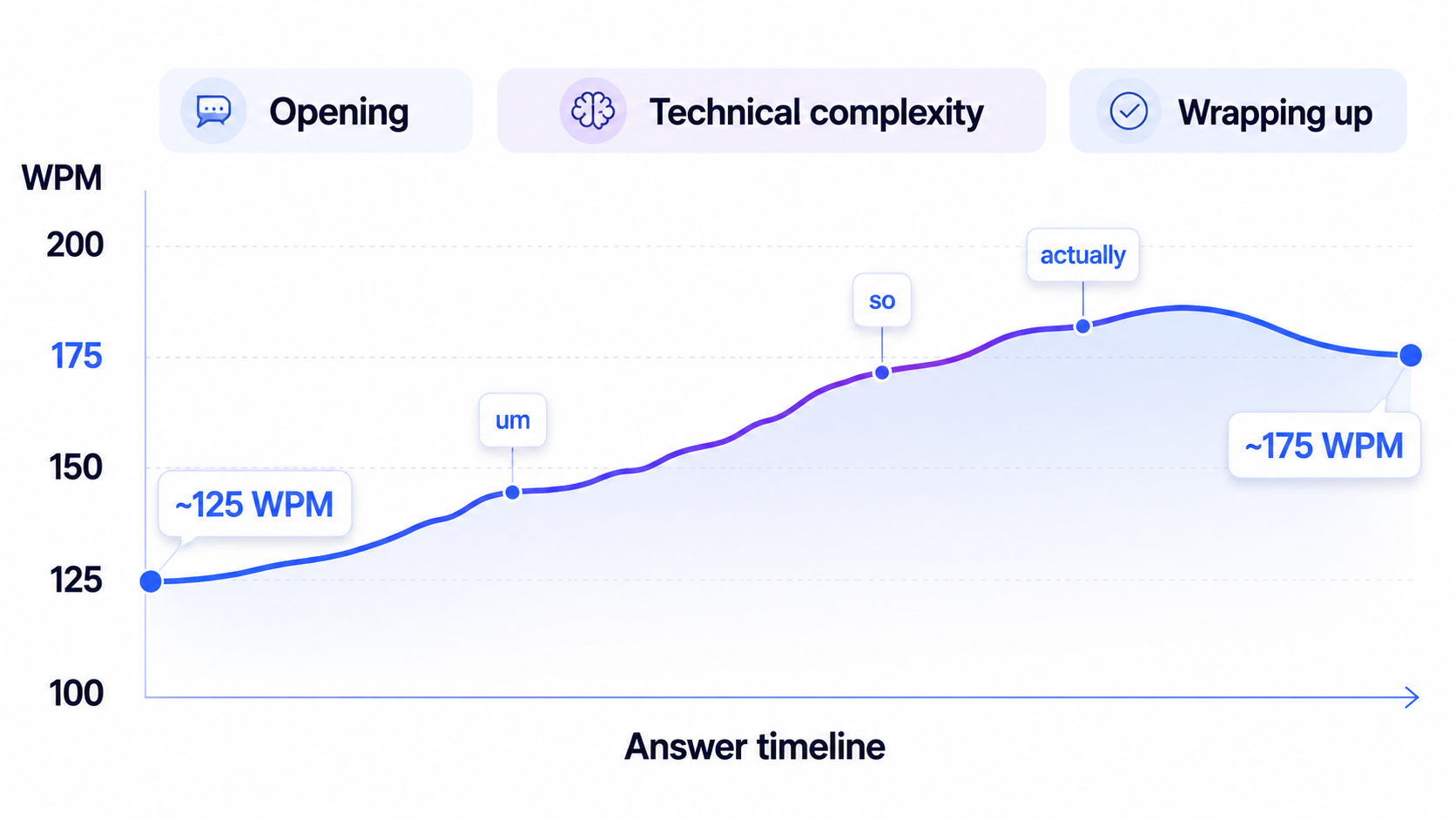
The solution is surprisingly simple: slow down more when the explanation becomes more technical.
That's counterintuitive at first. Stress naturally pushes in the opposite direction.
But experienced interview communicators deliberately create extra separation around important concepts.
They slow slightly before:
- key decisions,
- technical tradeoffs,
- explanations,
- or conclusions.
That pacing makes answers feel structured even before the interviewer consciously analyzes the content.
How to train for a better interview pace
You cannot reliably fix pacing through awareness alone.
In real interviews, adrenaline overrides intention. What feels “normal” during practice becomes fast under pressure.
That's why pacing has to become automatic.
The most effective way to train this is not reading articles silently or rehearsing mentally. It's spoken repetition with feedback.
Record yourself answering real technical questions for 60–90 seconds.
Then listen for three things:
- Are your ideas blending together?
- Do pauses happen between ideas or inside sentences?
- Would the answer still feel easy to follow for someone hearing it once?
Most people immediately notice that their internal perception of “calm” is much faster than reality.
Once you hear it, adjustment becomes easier.
Another useful technique is deliberate under-speeding during practice. Speak slightly slower than feels natural for a few sessions. Your nervous system gradually recalibrates.
After several days, the new pace stops feeling artificial.
Practical target: Aim for a pace that feels slightly slower than comfortable to you. In most cases, that's the range interviewers perceive as clear, confident, and senior-level.
Technical interviews reward clarity more than intensity
Candidates often assume they need to sound impressive.
But technical interviewers usually aren't looking for performance energy. They're looking for signal clarity.
Can this person explain ideas coherently? Can they organize information under pressure? Can teammates follow their reasoning? Can they communicate complex concepts without creating confusion?
Pacing directly affects all of those perceptions.
A calm 128-WPM explanation with clean structure almost always sounds more senior than a rushed 175-WPM answer with identical technical content.
That's especially true in English-language interviews, where interviewers unconsciously evaluate communication effort.
The easier you are to follow, the stronger your answers feel.
And that's the important reframing: the goal isn't to sound slower.
The goal is to sound easier to understand.