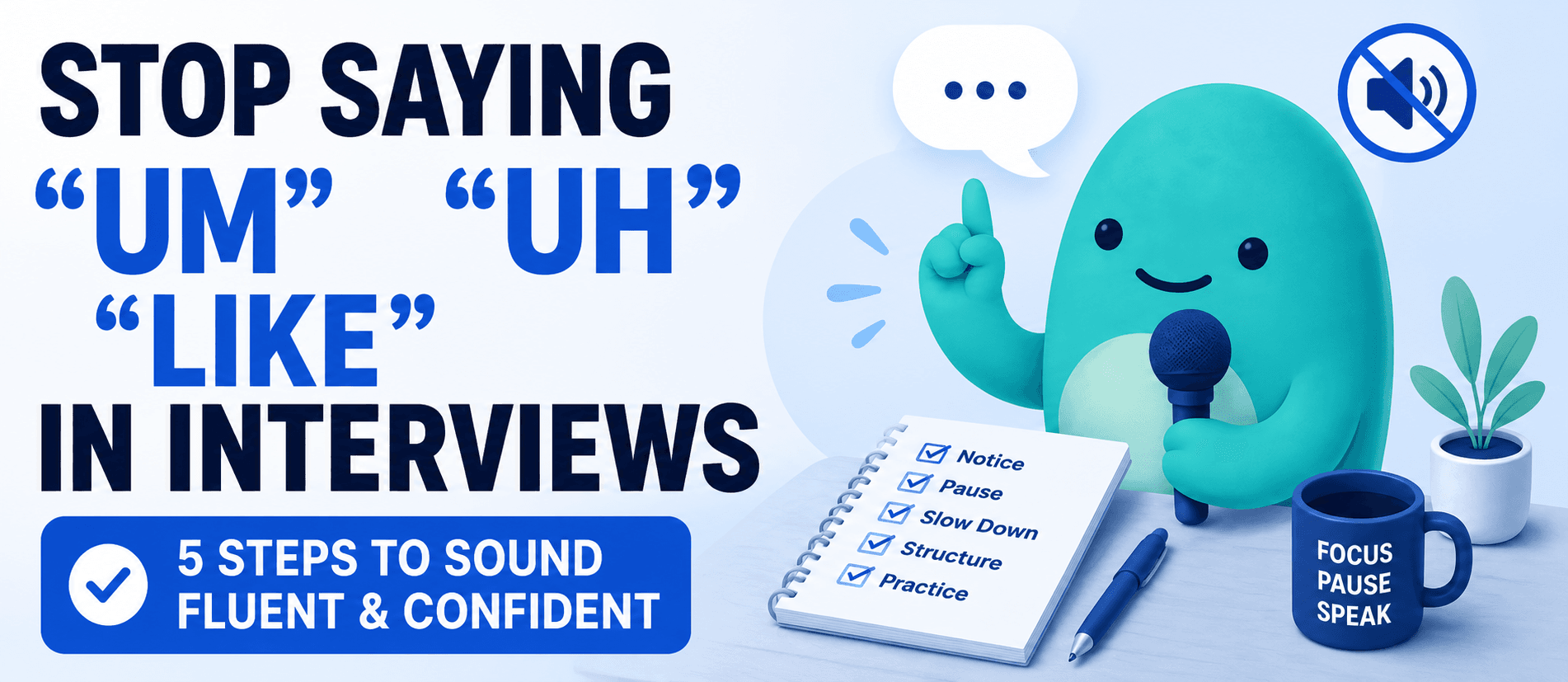
You've prepared your answers. You know the material. But the moment the interviewer asks a question, your mouth fills with "um", "uh", "like", and "you know". This is one of the most common — and most fixable — problems candidates face in English-language interviews.
Filler words aren't a sign of low intelligence. They're a sign that your brain is processing faster than your mouth can keep up. In your native language, you've had years to develop strategies for these pauses. In English, most non-native speakers haven't — yet.
WhalePrep data point: Candidates who practice for 10+ days reduce filler word rate from an average of 14% to under 5% — a level most interviewers don't notice.
Why filler words hurt your interview performance
Research on spoken communication consistently shows that listeners perceive speakers with high filler-word rates as less competent, less prepared, and less confident — even when the content of their answers is identical to speakers with low filler rates.
In an English interview specifically, the cognitive load of speaking a second language amplifies the problem. Your working memory is managing translation, vocabulary retrieval, grammar, and structure simultaneously. Filler words are the overflow valve.
Step 1: Notice your fillers before you fix them
You can't reduce what you can't hear. Most people are genuinely unaware of how often they use filler words until they hear a recording of themselves. This is the uncomfortable-but-necessary first step.
Record yourself answering one question
Pick any common interview question — "Tell me about yourself" works well. Answer it out loud for 90 seconds. Play it back and count how many times you say "um", "uh", "like", "you know", "so", "basically", or "actually" as a filler (not a content word).
If you're using WhalePrep, this is done for you: after every session, the filler-word count and percentage appear immediately in your feedback card.
Step 2: Replace fillers with deliberate silence
The most effective technique is also the simplest: replace every filler with a pause. A 1–2 second silent pause sounds confident and thoughtful. "Um" sounds hesitant.
The key insight: Silence feels much longer to the speaker than to the listener. A pause that feels like 3 seconds to you registers as 1 second to the interviewer — and reads as composure.
Practice this by reading your answers aloud and physically stopping — closing your mouth — every time you feel a filler coming. It will feel awkward at first. After 20–30 repetitions, the habit starts to form.
Step 3: Slow down your baseline pace
Filler words often appear when you're speaking too fast and running out of buffer. Slowing from 160 WPM to 120–135 WPM gives your brain more time to select the next word before you need it — which means fewer gaps to fill with "um".
- Speak at a pace that feels slightly slower than natural to you
- Pause at the end of each idea, not in the middle of a phrase
- Don't rush to fill silence after a question — it's okay to think for 2–3 seconds before starting your answer
Step 4: Use a structure so you always know what comes next
Filler words often appear at transition points: when you've finished one thought and aren't sure what comes next. A simple answer framework eliminates these gaps because you always know where you're going.
The STAR method (Situation → Task → Action → Result) is the standard for behavioural questions. For technical or conceptual questions, a simple three-point structure — First… Second… Third… — is enough to eliminate most mid-answer confusion.
Step 5: Practice under realistic conditions
Reading tips doesn't build habits. Speaking does. The research on motor learning is clear: you need spaced repetition — multiple short sessions over days — not one long cram session.
10–15 minutes of daily spoken practice, with immediate feedback on filler-word rate, produces measurable improvement within a week. This is exactly what WhalePrep is designed for: real interview questions, spoken out loud, with a filler-word count in your feedback every time.
Practical target: Aim to get your filler rate below 5% before your interview. At that level, interviewers typically don't notice — and your answers come across as fluent and prepared.