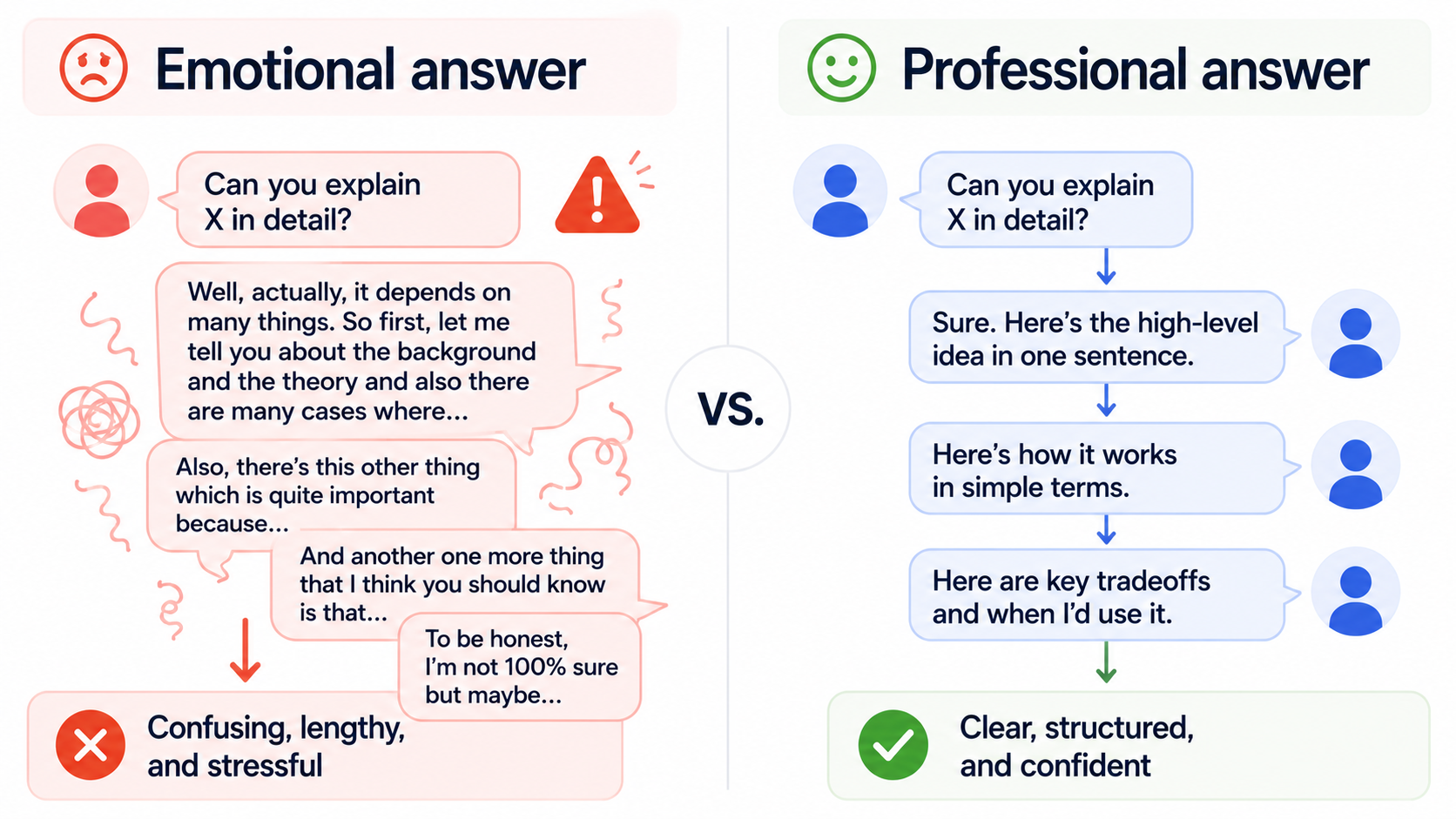
Most candidates misunderstand conflict questions.
When an interviewer asks:
“Tell me about a conflict.” “Describe a disagreement with a coworker.” “Tell me about a difficult stakeholder.”
they are usually not trying to discover whether conflict happened.
Conflict is normal. Every experienced professional has it.
What they actually want to understand is:
- how you behave under tension,
- whether you become defensive,
- whether you communicate clearly,
- and whether you can solve problems without creating emotional chaos.
A strong answer makes you sound calm, collaborative, and self-aware.
A weak answer makes you sound like:
- the source of drama,
- emotionally reactive,
- or difficult to work with.
Key insight: In culture interviews, interviewers often evaluate emotional stability more than the conflict itself. A calm delivery matters as much as the story.
One important thing many non-native English speakers do accidentally is over-explaining emotions.
For example:
“I was extremely frustrated because they always ignored my ideas and honestly I felt very upset about the whole situation…”
This immediately shifts the tone from:
professional conflict
to:
personal emotional conflict.
In English-speaking tech companies, good conflict answers usually sound:
- measured,
- factual,
- and solution-oriented.
Not cold — just controlled.
What strong answers usually include
A good conflict answer normally contains three things:
- A real disagreement or tension
- A constructive action you took
- A positive or professional resolution
The interviewer wants to leave the conversation thinking:
“This person is mature under pressure.”
Not:
“This person might be exhausting in meetings.”