Many candidates think live SQL interviews are mainly testing syntax accuracy.
Usually, they are not.
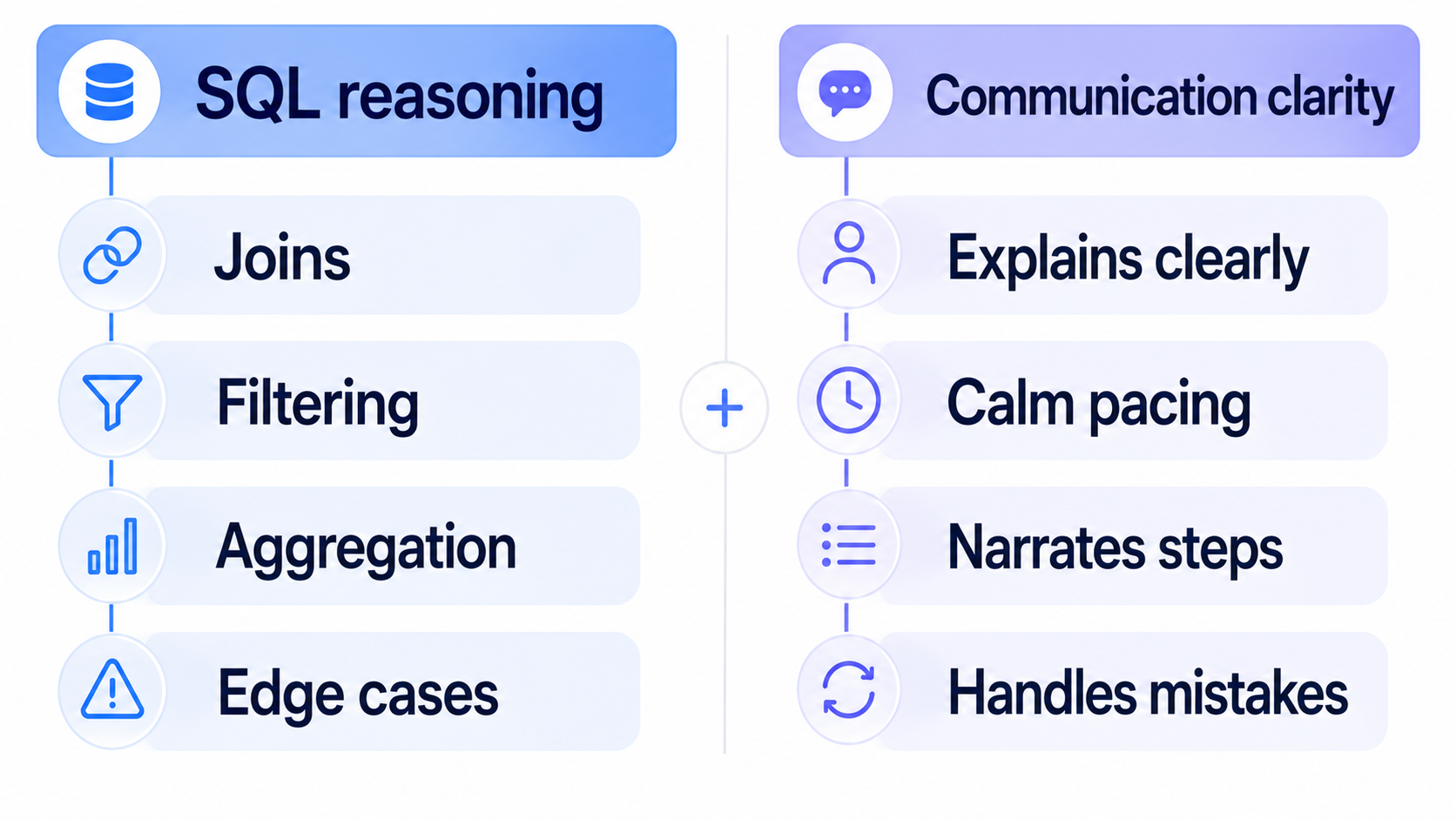
In most English-language SQL interviews, the interviewer is evaluating two things simultaneously:
Track 1: SQL reasoning
- Can you break the problem into logical steps?
- Do you understand joins, filtering, grouping, and aggregation?
- Can you explain trade-offs or assumptions?
- Do you notice edge cases?
Track 2: Communication clarity
- Can the interviewer follow your thinking easily?
- Do you explain decisions before typing?
- Do you sound calm under pressure?
- Can you recover smoothly after mistakes?
Key insight: Strong candidates narrate their thinking before they type. Weak candidates silently write SQL for 90 seconds, then suddenly explain everything at once.
The biggest mistake non-native speakers make is trying to produce “perfect English” while simultaneously solving the SQL problem.
That creates overload.
The goal is not perfect English.
The goal is:
- clear structure,
- predictable pacing,
- and visible reasoning.
A calm explanation with minor grammar mistakes usually performs much better than perfect SQL delivered in silence.
What strong candidates usually sound like
Instead of:
“Uh… let me think… maybe… wait…”
strong candidates often say:
“First, I want to identify the relevant tables. Then I’ll join them before calculating the aggregation.”
That sentence instantly creates confidence because the interviewer can follow the path ahead.