Most candidates prepare SQL interviews the wrong way.
They memorize JOIN syntax. Rehearse window functions. Grind LeetCode-style exercises for hours.
Then the interview starts — and they freeze halfway through explaining a query they actually know how to write.
Because in a real data analyst interview, SQL is rarely evaluated in silence. You're expected to think aloud, explain tradeoffs, clarify assumptions, and walk the interviewer through your reasoning while writing the query.
And for non-native English speakers, that second layer is often harder than the SQL itself.
WhalePrep observation: Many technically strong candidates fail SQL interviews not because the query is wrong — but because their reasoning becomes difficult to follow under pressure.
What interviewers are actually evaluating
A surprising number of SQL interviews are not primarily about syntax accuracy.
Interviewers already assume you can Google exact syntax details on the job. What they want to understand is how you think through messy business problems using data.
That changes the interview dynamic completely.
They're watching for signals like:
- Can you translate a vague business question into a data problem?
- Do you structure your thinking before writing SQL?
- Can you explain assumptions clearly?
- Do you notice edge cases?
- Can another human follow your logic?
The strongest candidates sound collaborative while solving problems. Not robotic. Not overly academic.
This is why simply practicing silent SQL exercises often doesn't transfer well to live interviews.
The most common SQL interview question types
Most data analyst SQL interviews revolve around the same small group of patterns.
Not because companies lack creativity — but because these patterns reveal how candidates reason about data.
Aggregation and grouping questions
These are the classic "top customers", "monthly revenue", or "daily active users" problems.
They're deceptively simple.
The challenge usually isn't writing GROUP BY. It's deciding what exactly should be grouped and whether the business definition is actually clear.
For example, if an interviewer asks for "active users", strong candidates pause and clarify:
- Active based on login?
- Purchase?
- Session?
- Unique per day or per month?
That clarification step matters more than people think.
Key insight: Interviewers often intentionally leave business definitions ambiguous to see whether you ask questions before writing SQL.
JOIN-heavy questions
These test whether you understand relationships between tables — but also whether you understand why the relationship matters.
A weak answer sounds like syntax recitation:
“I would LEFT JOIN this table here.”
A strong answer sounds analytical:
“I’d start from the orders table because it defines the grain of the result we want. Then I’d LEFT JOIN users so we don’t accidentally drop unmatched orders.”
That second explanation signals real data thinking.
Funnel and conversion analysis
These questions appear constantly in product and growth-focused companies.
You'll often need to track users through multiple events:
- viewed page,
- clicked CTA,
- signed up,
- purchased.
The SQL itself can become complex quickly. But interviewers mainly want to hear whether you can break the problem into stages instead of trying to solve everything in one giant query immediately.
Why candidates struggle to explain SQL clearly in English
SQL interviews create a unique kind of cognitive overload for non-native speakers.
You're simultaneously:
- solving logic problems,
- remembering syntax,
- translating thoughts,
- speaking professionally,
- and managing interview anxiety.
That's a lot of parallel processing.
Many candidates start strong, then lose fluency midway through the explanation. Sentences become fragmented. Filler words spike. The structure disappears.
Not because they lack SQL knowledge — but because their working memory gets overloaded.
One of the most effective fixes is surprisingly simple: narrate smaller chunks.
Instead of trying to explain the entire solution upfront, walk through your reasoning incrementally.
For example:
“First I want to identify the base table. Then I’ll calculate the metric per user. After that I can aggregate by month.”
That kind of verbal signposting dramatically improves clarity.
Why this works: Interviewers don't need perfect English. They need a stable mental map of your reasoning.
A simple structure for walking through SQL problems
Strong SQL interview answers usually follow a predictable communication rhythm.
Not because candidates memorize scripts — but because structured thinking naturally sounds clearer.
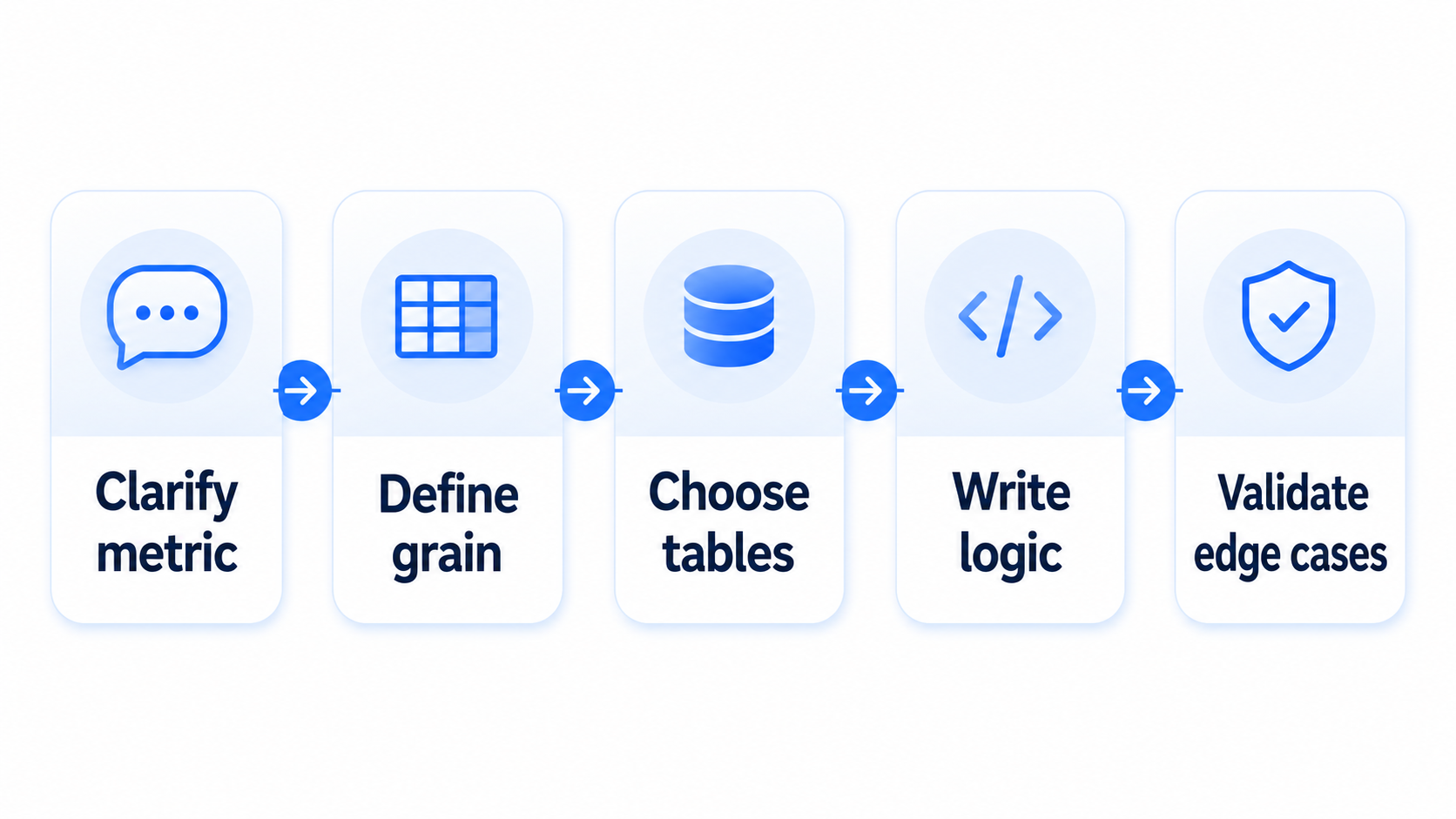
A practical framework looks like this:
1. Restate the business question
Briefly confirm what problem you're solving.
This avoids solving the wrong problem for 15 minutes.
For example:
“So we want to measure monthly retention for users who signed up in the previous month, correct?”
That one sentence immediately makes you sound more methodical.
2. Define the data grain
This is one of the most overlooked interview skills.
Before writing SQL, explain what each row of your output represents.
Examples:
- one row per customer,
- one row per order,
- one row per month,
- one row per user-session pair.
Candidates who clarify grain early tend to sound dramatically more senior.
3. Explain the plan before typing
You don't need a long monologue.
Just a short roadmap:
“I’ll probably use a CTE to isolate purchases first, then aggregate by customer after filtering duplicates.”
Now the interviewer can follow your decisions as they happen.
4. Validate edge cases out loud
This is where strong candidates separate themselves.
Mentioning issues like:
- duplicate rows,
- null values,
- timezone inconsistencies,
- missing joins,
- or division-by-zero cases
signals real production experience.
Practical target: Your interviewer should almost always understand why you're writing each part of the query before you type it.
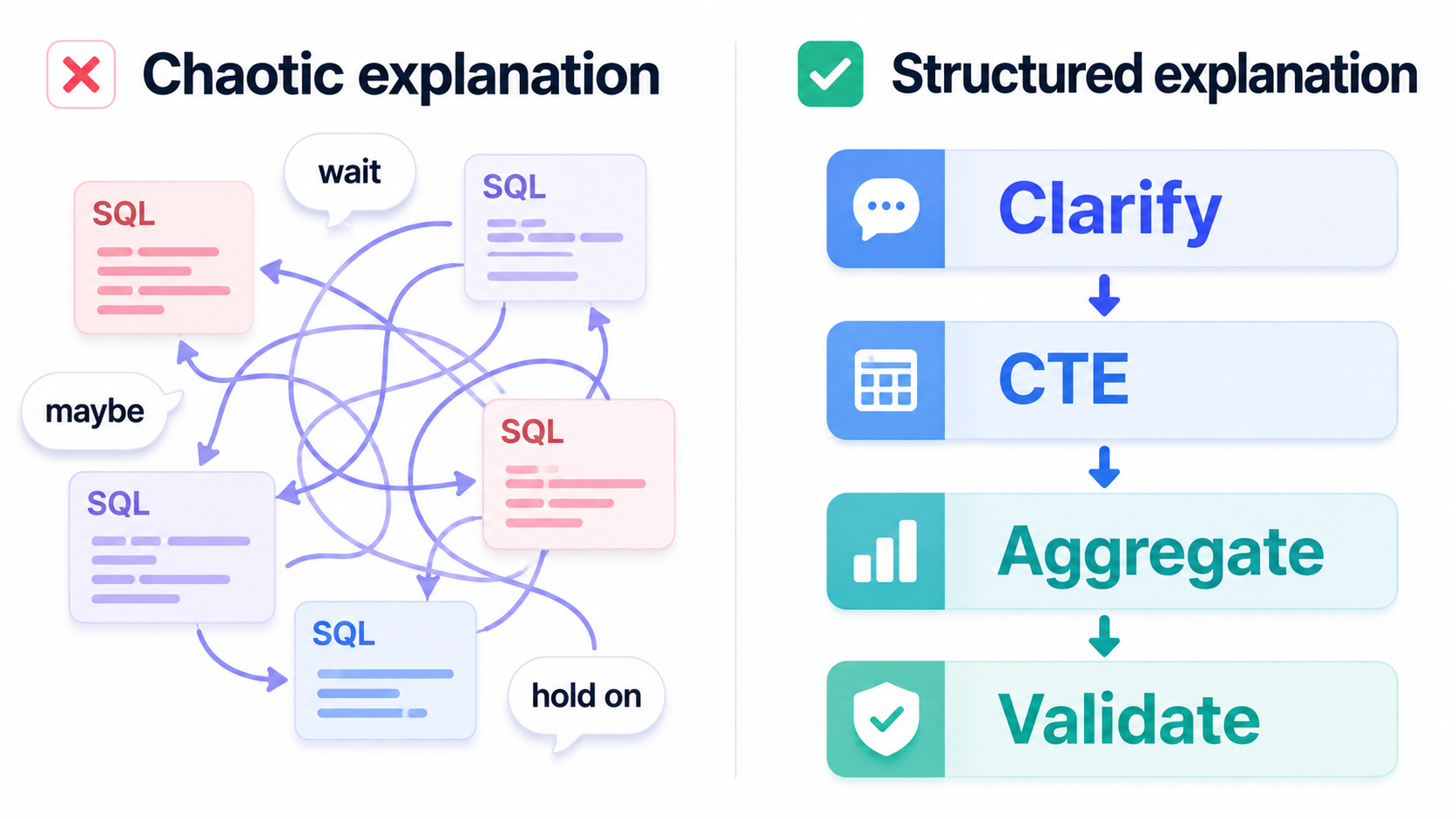
The mistake that makes SQL answers feel chaotic
Many candidates treat SQL interviews like coding competitions.
They rush.
Typing becomes the priority. Communication disappears.
Ironically, this often creates more mistakes — because the interviewer can't follow the logic well enough to help guide the conversation.
The strongest SQL interviewers usually move slower than expected.
They pause.
They think aloud.
They correct themselves calmly when needed.
And most importantly: they keep the interviewer cognitively synced with their reasoning.
How to practice SQL interviews more effectively
Most SQL preparation focuses entirely on correctness.
But interview performance depends heavily on verbal fluency under pressure.
That means your practice should include spoken reasoning — not just silent query writing.
One effective exercise is simple:
Pick a SQL question and explain your approach out loud before writing anything.
Even alone.
Even if it feels awkward.
At first, you'll notice gaps immediately:
- unclear transitions,
- filler words,
- lost train of thought,
- overcomplicated explanations.
That's useful feedback.
Over time, your verbal structure becomes smoother — and interviews start feeling slower and more manageable.
Another important shift: stop optimizing for "perfect query speed."
Real interviewers care far more about clean reasoning than hyper-fast syntax recall.
WhalePrep pattern: Candidates who slow down slightly often perform better because their explanations become easier to trust and follow.
What strong SQL interview communication actually sounds like
Strong candidates rarely sound overly polished.
They sound clear.
There's a difference.
Good SQL interview communication usually includes phrases like:
- “I’m assuming…”
- “The grain here would be…”
- “I’d probably separate this into a CTE first…”
- “One edge case I’d want to check is…”
- “I’m thinking aloud here…”
These phrases create transparency.
The interviewer feels included in your thought process instead of forced to reverse-engineer it from raw SQL.
And that collaborative feeling matters much more than most candidates realize.
Final takeaway
SQL interviews are not just tests of technical correctness.
They're communication interviews disguised as technical exercises.
The candidates who consistently perform best are usually not the fastest typers or the people with the most memorized syntax.
They're the ones who can make their reasoning easy to follow under pressure.
That means slowing down enough to structure your thoughts, narrating decisions clearly, and treating the interview like a collaborative analytical discussion — not a race.
Practical target: Before your next SQL interview, practice explaining 5 common SQL problems out loud from start to finish — even without writing the full query. Clarity compounds fast.